Arab-German Metamorphoses


AGYA at the Salon Sophie Charlotte 2025
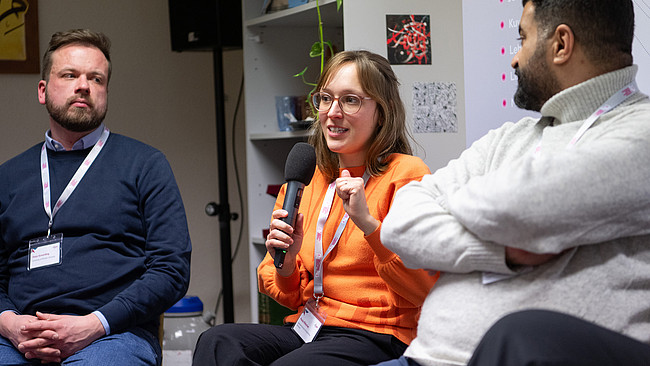
Having a cup of tea or coffee together, taking a short break, and talking to each other is a shared cultural practice in Arab and German societies – a small, everyday transition from the rush of life into moments of connection and reflection. AGYA invited the honourable guests of this year’s Salon to a Science Café to engage with members and alumni from Iraq, Egypt, UAE, Algeria, Oman, the Netherlands, and Germany to delve into academic and cultural exchange. Sharing experiences and exchanging ideas is key in a transformative world – AGYA members and alumni told their stories from how they have changed over the course of their active AGYA memberships and how this shaped their work as researchers today.
Books on Wheels in Iraq – Rebuilding Society through Reading
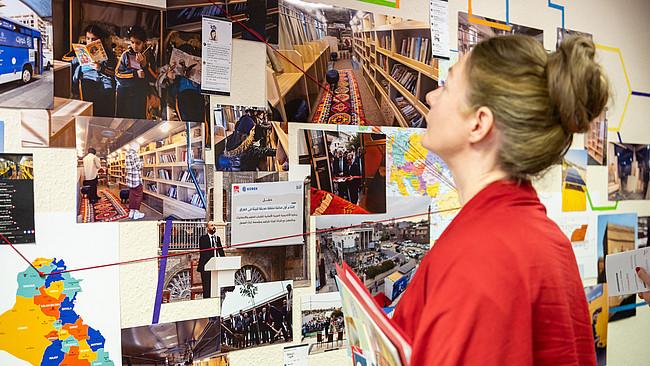
In a wall installation, AGYA members Prof. Dr. Abdulsatar Sultan, Prof Dr. Sonja Buxbaum-Conradi and AGYA Alumnus Dr. Konstantin Klein showcased the first mobile library in Iraq. The exhibition followed the metamorphosis of an old school bus into a library and how it got rolling. Since almost one year, the bus tours Mosul and its surrounding communities, where the educational infrastructure has been mostly destroyed by war. The mobile library is especially providing a place to connect in remote areas to disseminate knowledge and create space for encounters.
Arab-German Metamorphoses: Transformation by Research Cooperation
Hosted by AGYA Principal Investigator Prof. Dr. Verena Lepper the main stage presented more than ten years of AGYA’s endeavours in Arab-German research cooperation that have shown one thing in abundance: jointly conducting research across disciplines and borders in the framework of a self-governed young academy is an experience with a long-lasting if not transformative impact.
Same, same but different: The Virtual Unwrapping of Papyri
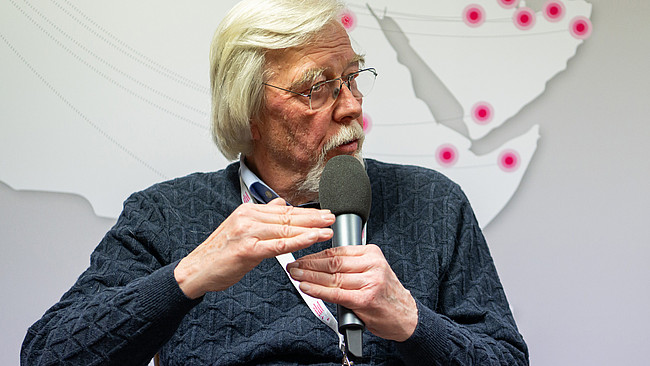
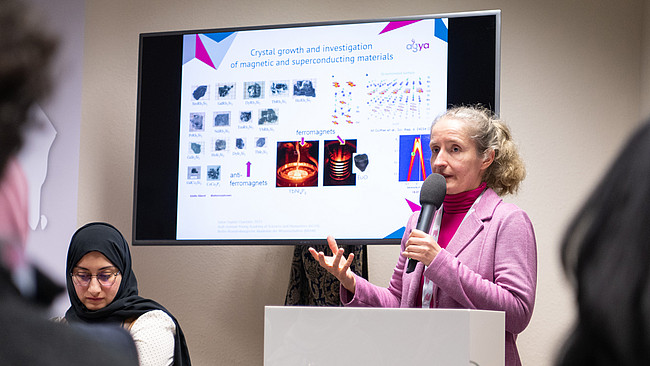
Shared success stories from Arab–German research collaborations highlighted the essence of learning by demonstrating how interdisciplinary cooperation among Egyptologists, mathematicians, and computer scientists has made it possible to virtually unfold ancient papyri. Virtually unfolding millennia-old papyri and revealing ancient writings is surely one of the more exciting experiences science holds for us. For this, Egyptologists use the latest technologies to examine tightly folded and extremely porous papyri to make the ink visible. By using the radiation in a synchrotron they create a digital twin of the papyrus – a virtual metamorphosis. AGYA Principal Investigator Verena Lepper presented ground-breaking research and discussed with the President of the SESAME Council Prof. Dr. Rolf-Dieter Heuer how new technical methods and interdisciplinary collaboration are changing entire fields of research and research practices.
Transforming Nutrition: Innovating Crops & Securing Clean Foods
A panel discussion explored innovations in agriculture and nutrition, with a special focus on securing clean and sustainable food sources and supply chain resilience during political instability.
AGYA alumna Dr. Henda Mahmoudi together with Urte Grauwinkel (Soil Biogeochemistry, Martin Luther Universität Halle-Wittenberg) and AGYA member Prof. Dr. Tilal Abdelhalim addressed the challenges of transforming food systems In the panel discussion, experts examined the obstacles to establishing millet as a staple food and transforming Germany into a “millet nation” to address rising global demands, noting that millet is already a well-established crop in countries such as Sudan.The discussion, moderated by AGYA member Dr. Claire Bullen, highlighted innovative strategies in the field of food security and smart agriculture to transform nutrition systems with inspiring examples from Sudan, UAE and Germany.
Educational Shifts: Things We Need to Change
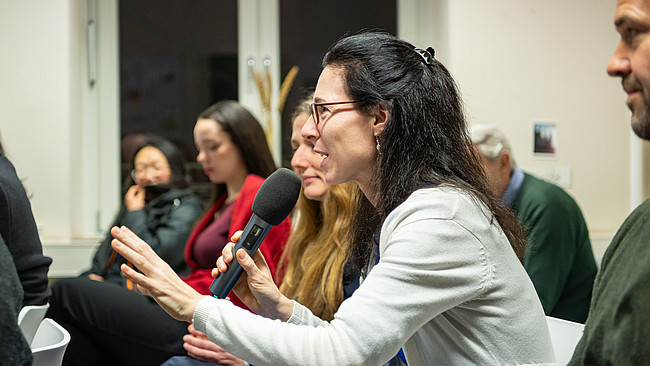
AGYA engaged with the format of a participatory discussion, means to actively involve the audience and ask them the following questions: How do we envision the future of education in a rapidly evolving world? How can teaching Arabic in German schools improve mutual understanding? How does generative AI impact learning and teaching? The esteemed audience of the Salon explored with Paula Rötscher (School teacher for Arabic as a foreign language, Schnepfenthal) as well as AGYA members Dr. Peter Konerding, Dr. Ayham Zaitouny and AGYA Co-President Prof. Dr. Faouzia Zeraoulia how Arab-German approaches can foster educational settings in social transformation processes and in (post-)conflict societies that are oriented towards reconciliation and peace. The thought-provoking discussion on the metamorphosis of education, moderated by AGYA Co-President Prof Dr. Dawud Ansari , set the agenda and determined which topics shall be prioritized and explored to stear the future of education.
Metamorphosis Matters: The Transformative Power of Crystals, Light and Conductivity
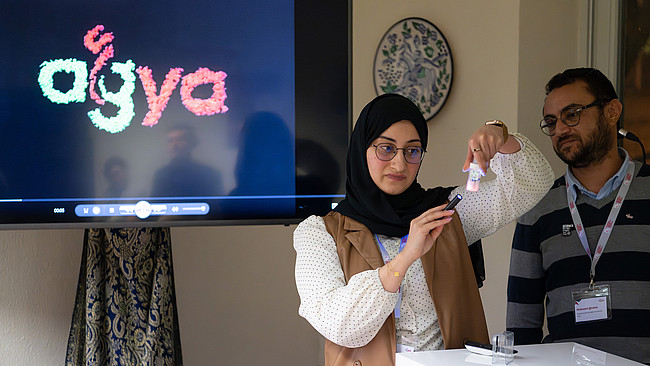
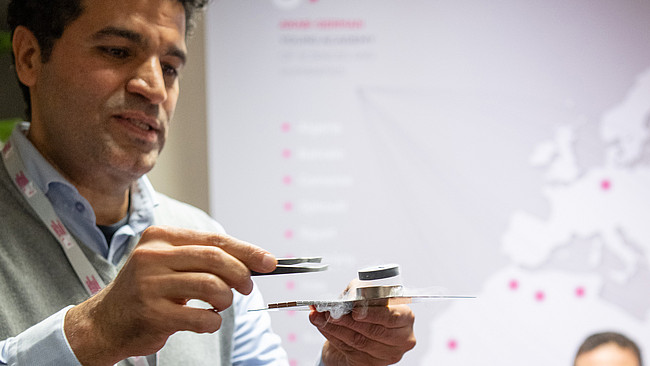
The transition to fossil free energy production relies on the optimal preparation of materials to harvest solar energy and improve conductivity. In one of three live experiments in a Science Show, AGYA member Dr. Kristin Kliemt illustrated the conversion of sand to single crystals, used in solar cells. AGYA member Dr. Mohamed Qenawy used light active materials to showcase the basic mechanisms of solar energy harvesting. Utilizing a high-temperature superconductor cooled with liquid nitrogen, AGYA alumnus Prof. Dr. Mahmoud Abdel-Hafiez demonstrated magnetic levitation. All member and alumni join forces within AGYA to better understand the core functionalities driving the transition into a more sustainable way of living.
Live Metamorphosis: When Researchers Improvise!
To joyfully conclude the evening, AGYA members and alumni explored the transformative power of improvisation: PowerPoint Karaoke. In this engaging session, they navigated unexpected slides and unfamiliar content from fellow members’ presentations, giving rise to spontaneous interpretations and unanticipated connections – all in real time. Both insightful and entertaining, this finale showed intellectual agility with a touch of humour. Here, the audience could finally witness the metamorphosis of researchers themselves in action – with the take-home message that knowledge does unfold in unpredictable ways

Date and Venue
18 January 2025
Berlin-Brandenburg Academy of Sciences and Humanities (BBAW), Germany