Working Group Project
Community-based Responses to Energy, Water, and Food Crises
Case Study Report
Natural disasters, armed conflict, institutional collapse, and economic crises can profoundly disrupt the provision of public goods, depriving communities of electricity, water, and food—and often of any central authority able to restore them. In response, communities self-organize, adapt, and rebuild.
Why community responses matter
From Yemen and Sudan to Morocco and Palestine, overlapping crises are exposing the limits of centralized systems. Communities that cannot wait for state recovery are turning to decentralized solutions: solar microgrids, water harvesting systems, community-managed kiosks, agroforestry networks, and cooperative food schemes.
Communities in Germany face similar questions. Severe floods, energy market disruptions, and drought have prompted German communities to experiment with citizen-owned renewable cooperatives, urban rainwater management, and solidarity-based agriculture.
These responses are not driven by necessity alone. New technologies and distributed infrastructure are opening pathways for bottom-up action that were previously unavailable. A solar panel on a rooftop, a community battery system, or a shared water kiosk can fundamentally change what a neighborhood is capable of and what it expects from the local governments.
Community-led responses are not merely substitutes for absent state capacity — they can become instruments of targeted social development and lasting resilience.
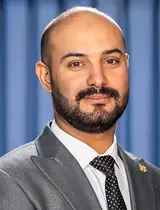
AGYA member Mohammad Al-Saidi, Hamad Bin Khalifa University, Qatar
Two regions, one conversation
Across the Arab region, communities caught in conflict, displacement, or environmental degradation have pioneered decentralized approaches to survival and recovery. Case studies include off-grid solar and water solutions in Yemen, community-managed water kiosks in Gaza, participatory agroforestry in Sudan, earthquake responses in Marrakech, smart rural innovations in Egypt, and solar-powered desalination in the UAE.
In Germany, citizen-owned wind and solar cooperatives, urban rainwater management initiatives, community-supported agriculture networks, and local flood management responses tell a parallel story of communities building resilience from the ground up.
Knowledge that empowers
This AGYA Working Group Project examines these responses through a curated set of empirical case studies, each grounded in a real community response to a sustained or recurrent crisis. Every case study explores both the technology deployed and the social dynamics that are involved, such as the roles of local actors, decision-making structures, power relations, and questions of governance, trust, and inclusion. Beyond the case studies, the project brings in broader voices through academic impulse papers, initiative profiles, and overarching recommendations. By mapping what actually works and why, and under what conditions, the project builds a shared knowledge base for addressing some of the most pressing global challenges. The research results are compiled in a comprehensive AGYA report featuring in-depth case studies, academic essays, and policy recommendations, published in open-access format.
The members of the Working Group extend their gratitude to the project assistants, Mr. Wassim Brahim, Mr. Ahmed Hasoba and Ms. Hagar Ahmed Mekky, who play a crucial role in developing the report and data collection.

Solar pumping station for water abstraction in Sana’a, Yemen Mohammad Al-Saidi
- Disciplines involved
- Economics, Political Sciences, Agricultural Engineering, Business Management, Electrical Engineering, Pharmacy, Chemistry, Physical Education
- Project Title
- Community-based Responses to Energy, Water, and Food Crises
- Year
- 2025
- Funding Scheme
- Working Group Project
- Working Group
- Energy, Water and Environment
- Countries Involved
- Egypt, Germany, Iraq, Libya, Oman, Qatar, Sudan, United Arab Emirates